
A large volume of documents. 38 suppliers. 9 currencies. That kind of paperwork can turn a growing Shopify or Amazon FBA business into a daily fire drill. SupplyAutomate brings those orders, supplier files, and cost details into one workflow, so you can see what is late and what each unit really costs.
This review looks at SupplyAutomate beside the main Shopify supply chain app categories. It also covers setup, supplier connections, Amazon workflows, AliExpress use cases, security, and the limits you should test before you commit.
1. SupplyAutomate
SupplyAutomate is built for Amazon FBA sellers, Shopify store owners, and small to mid-sized e-commerce teams that buy from suppliers. It combines AI document processing with landed-cost tracking, which means you can see product cost after freight, duty, and other charges.
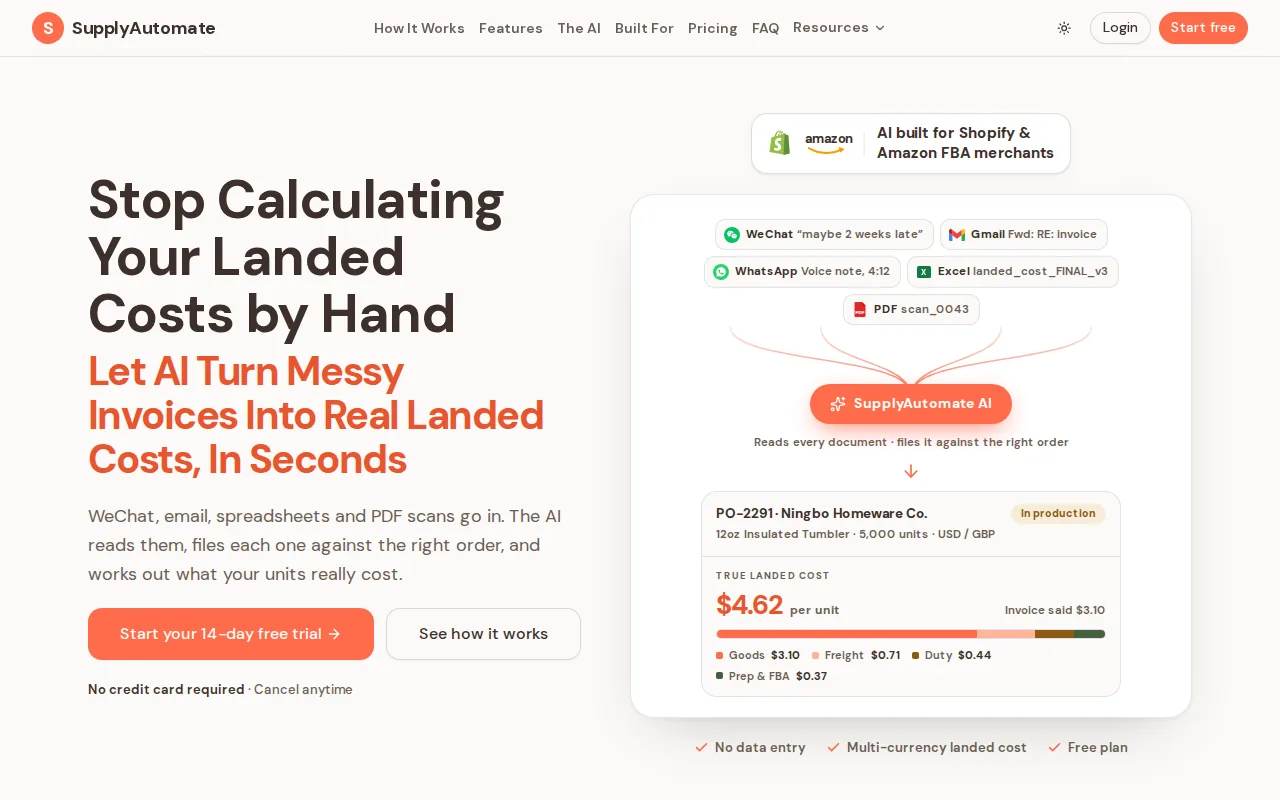
That focus is the main reason it earns the first spot in this review. Many Shopify apps handle one narrow task. SupplyAutomate connects the work around a purchase order, or PO, so supplier messages, invoices, freight bills, and shipment details stay tied to the right order.

We use AI to read uploaded documents and match them to orders. The result is less manual entry when you receive a supplier invoice or duty receipt. You can then review the cost of a SKU before setting a price or judging a product's margin.
That matters when the factory quote looks good but freight changes the math. A product may have a low unit price and still lose money after transport and import charges. SupplyAutomate puts that calculation in the same operating view as the order. The method behind it is set out in this guide to calculating landed cost for imported products.
For a closer look at the workflow, see the purchase invoice processing software comparison.
The caveat is simple. SupplyAutomate is not meant to replace every warehouse, shipping, or marketplace system. If your main problem is barcode scanning inside a large warehouse, you may need a separate warehouse management tool. If the pain is supplier paperwork and unclear unit cost, SupplyAutomate is the sharper fit.
Start with one active PO and its related files. Ask one question: can the system show the cost of that order without another spreadsheet? If you are still assembling those orders by hand, the guide to creating a purchase order covers the fields worth capturing first.
Key Takeaway: SupplyAutomate is strongest when Amazon FBA or Shopify operations need supplier records, documents, orders, and landed cost in one place.
Shopify Supply Chain App Categories and the Benefits They Deliver
A Shopify supply chain app usually focuses on one layer of the order flow. The main categories are inventory planning, order management, fulfillment, multichannel sync, and returns.

Inventory apps watch stock levels and help estimate when a product needs a reorder. Forthcast uses Shopify sales data for AI demand forecasts. Prediko focuses on inventory management for Shopify brands and connects with channels such as Amazon, TikTok Shop, 3PL systems, and warehouse tools.
Order and fulfillment apps move an order toward the right warehouse or service. Cin7 Core supports Shopify, Amazon, wholesale, and retail POS workflows. Its stated focus includes fulfillment, purchasing, reporting, and demand forecasting.
Returns tools solve a different problem. Forthroute handles return authorization, shipping labels, and inventory restocking. That can help a fashion store keep a returned item from sitting in a queue while its stock record stays wrong.
There are also apps built for one operational view. Forthmatch tracks 3PL performance for high-volume Shopify stores. Assisty takes a reporting-first approach with more than 300 prebuilt inventory reports. These tools can be useful, but they don't necessarily explain the full cost of bringing goods into stock.
SupplyAutomate's benefit is different. It connects Amazon FBA and Shopify while focusing on documents, supplier communication, orders, and landed cost. The listed apps automate specific tasks, including demand forecasting, returns, 3PL tracking, and reporting.
Free plans are also narrow. Forthroute, Forthmatch, and Assisty each list a free plan for their focused functions: returns, 3PL tracking, and reporting.
Use the e-commerce inventory management software comparison when stock planning is your main concern. But don't choose an inventory app by integration count alone. Three integrations can still mean shallow data flow, while two focused channels may give you better cost control.
For a store that sells on Shopify and Amazon, the useful test is operational. Can the app tell you which stock is available, which order is late, and what the item cost after import? Timing is part of that answer, and the reorder point formula for importers shows how supplier lead time turns into a reorder date you can hold.
How to Install and Configure a Shopify Supply Chain App
Installing a Shopify supply chain app is quick. Configuring it well takes more care because wrong permissions or SKU data can spread errors through your workflow.
Read the permission screen before approving access, especially when an app can view products, orders, locations, or customer data.
- Open the Shopify admin. Go to Apps, then open the Shopify App Store. Search for the app by its exact name.
- Review the listing. Check the app's purpose, pricing, developer, permissions, support details, and recent reviews. A supply chain app that asks for data outside its job deserves extra questions.
- Install and approve access. Select Install. Shopify will show the requested permissions and any charges before approval.
- Connect the store data. Choose the sales channel, locations, suppliers, and product groups you want to manage. Start with a small set of SKUs instead of importing your whole catalog on day one.
- Set supply chain stages. Use stages such as production, transport, customs, and receiving when the app supports them. Add the data points you need at each stage, such as ship date, expected arrival, freight cost, or duty receipt.
- Test one order. Compare the app's product, order, and cost record with your source documents. Fix SKU mismatches before you turn on automatic sync.
Review the linked app guidance as part of your installation review.
This consideration still helps merchants. Ask whether the app runs mainly in the admin or adds code to the storefront. The second case deserves a speed check after installation.
For SupplyAutomate, begin with your current supplier list and one recent order. The Amazon FBA supply chain software overview is available for reference.
Keep admin access limited during onboarding. Give installation rights only to the person who owns the store setup, then test team permissions before sharing the app with staff.
Pro Tip: Export or save a copy of your current SKU and inventory data before the first sync. It gives you a clean reference if a mapping rule needs to be undone.
Connecting Suppliers, Amazon, AliExpress, and Other Sales Channels
Supplier connections work best when every system uses the same SKU. A SKU is the code that identifies a product or variant. If the codes differ, orders may sync while inventory stays split across two records.
Amazon Multichannel Fulfillment, or MCF, shows how this handoff works. Its official Shopify integration lets merchants use Amazon inventory to fulfill Shopify orders. You connect the Amazon account, map Shopify products to Amazon SKUs, then set the shipping options that customers can see.
Matching names can allow automatic SKU mapping. If the Shopify SKU and Amazon SKU differ, individual mapping may be needed. That detail matters for large catalogs because the setup effort grows with every mismatch.
Once the connection is live, Shopify sends an eligible fulfillment request to Amazon. Amazon picks, packs, and ships the order, while tracking returns to the Shopify admin. MCF can also use a shared inventory pool across Amazon and Shopify, but you still need to decide which products belong at the Amazon fulfillment location.
AliExpress follows a different pattern. You install a connector through the Shopify App Store, review its data access, then link the AliExpress account and select products. The app may import product details and submit orders to the supplier, but you must still check supplier stock, shipping times, product quality, and return rules.
The same rule applies to other dropship partners. Do not treat a connection as proof that the supply chain is under control. Test the complete path: customer order, supplier acceptance, shipment tracking, inventory update, and return handling. A supplier evaluation matrix gives you a way to score those partners before volume depends on them.
SupplyAutomate fits beside these channel links by keeping supplier documents and landed cost visible. See the supplier management software comparison for related purchasing workflows.
Integration breadth can mislead. Prediko lists more channels than SupplyAutomate, while Cin7 Core includes wholesale and retail POS. More connections do not always mean better cost insight. Choose the app that gives your team the data needed for its next decision.
SupplyAutomate Compared With Other Shopify Supply Chain Apps
SupplyAutomate is the best fit in this group for import-heavy Shopify and Amazon FBA sellers who need document automation and landed-cost control. The other named apps are useful when the job is narrower.
| App | Best fit | Main strength | Watch for |
|---|---|---|---|
| SupplyAutomate | Amazon FBA and Shopify importers | AI document processing with landed-cost insight | Less suited to warehouse-floor workflows |
| Prediko | Shopify brands of many sizes | AI inventory planning across several channels | Focused on stock planning rather than supplier documents |
| Cin7 Core | Growing product businesses | Purchasing, fulfillment, reporting, and demand forecasting | May be more system than a small store needs |
| Forthcast | Stores that need demand forecasts | AI forecasts based on native Shopify sales data | Shopify integration is the listed focus |
| Forthroute | Stores with return volume | Return authorization, labels, and restocking | Does not cover the full import cost workflow |
| Forthmatch | High-volume Shopify operations | 3PL performance tracking | Designed around fulfillment monitoring |
| Assisty | Small stores needing reports | Reporting with a free plan listed | Reporting is not supplier lifecycle management |
Integration counts do not tell the whole story, because the functions differ widely. A tool with Amazon, TikTok Shop, and 3PL links may still leave you calculating freight and duty by hand.
Pricing needs the same care. Free options may be tied to narrow tasks. SupplyAutomate lists a 14-day trial with no card required, followed by a Free plan with a tracked invoice-value limit and a Pro plan at $99 per month. Check the current pricing page before buying because plan terms can change.
The SupplyAutomate pricing page is the right place to verify the current trial and plan details. Test the product with a real invoice set, not a clean demo file.
Choose Prediko when demand planning is the main problem. Choose Cin7 Core when you need broader product business operations. Choose a returns or 3PL tool when that single task is blocking your team. Choose SupplyAutomate when you need to connect supplier paperwork with the true cost of inventory.
FAQ
What is the best Shopify supply chain app?
SupplyAutomate is the strongest choice for Shopify sellers that also manage Amazon FBA inventory, supplier documents, and landed costs. It focuses on the work behind the sale, including purchase orders, invoices, freight records, and supplier communication. Stores focused only on forecasting, returns, or warehouse scanning may need a more specialized app.
Can Shopify connect to Amazon FBA?
Yes, Shopify can connect to Amazon FBA workflows through fulfillment apps. Amazon's Multichannel Fulfillment connection lets Shopify orders use Amazon inventory, with SKU mapping and shipping settings handled during setup. You don't need to sell on Amazon to use MCF, but inventory must be sent to Amazon before fulfillment can begin.
Can a Shopify supply chain app connect to AliExpress?
Yes, an AliExpress connector can link a Shopify store with supplier product and order data. You should review the app's permissions before installation, then test product import, order submission, stock updates, tracking, and returns. A working connection does not remove the need to check supplier quality or delivery times.
What does landed cost mean in e-commerce?
Landed cost is the total cost of getting a product ready for sale. It can include the supplier price plus freight, duty, customs charges, and related fees. A Shopify supply chain app that tracks only the supplier invoice may understate the true cost. SupplyAutomate is built to keep those cost records with the order.
Are Shopify supply chain apps secure?
Security depends on the app and the permissions it requests. Shopify shows requested access during installation, so review it before approval. Limit staff access, start with a test store or small SKU group when possible, and remove apps you no longer use.
Conclusion
Choose SupplyAutomate if supplier follow-up, import paperwork, and unclear landed cost are slowing your Shopify or Amazon FBA business. Start with one recent PO, upload its documents, and check whether the resulting cost view matches your books. If it does, move the rest of your active orders into the same workflow.