
Supply chain work gets messy fast when purchase orders, supplier updates, and import costs live in separate files.
The best supply chain management software depends on your sales model.
Here are the two strongest options in this shortlist, plus the buyer checks that separate a good fit from an expensive mismatch.
1. SupplyAutomate (Our Top Pick)
SupplyAutomate is supply chain management software built for e-commerce brands, especially Amazon FBA and Shopify sellers that import goods. We focus on the work that happens before inventory reaches your warehouse: purchase orders, supplier tracking, and landed cost calculations.
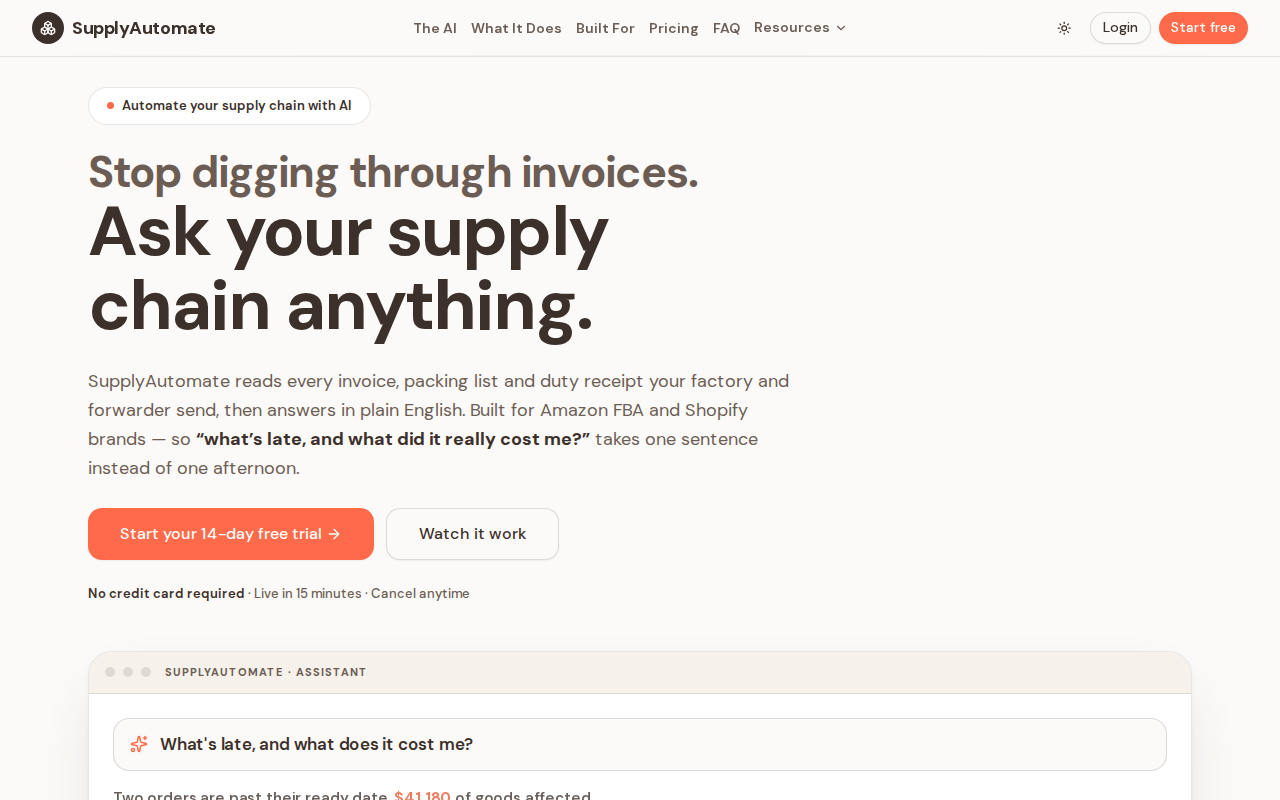
That focus is why SupplyAutomate takes the top spot. A purchase order, or PO, tells a supplier what to make or ship. The system keeps that order tied to the supplier workflow instead of leaving key details in email threads.
Landed cost is the full cost of getting a product ready to sell. It can include the supplier invoice, freight, duties, and other import charges. A product that looks profitable at the factory price may look very different once those costs reach the SKU level.
We built SupplyAutomate around that gap. The software automates purchase orders, tracks suppliers, and calculates landed costs in one workflow. That gives an e-commerce operator a better answer to a basic question: what did this product really cost me?
It also fits teams that work with documents from factories and freight partners. SupplyAutomate can read invoices, packing lists, and duty receipts, then connect those records to the supply chain workflow. The result is less manual sorting when costs arrive after the PO was approved.
For a closer look at the workflow, see the supply chain management software for e-commerce brands. It is aimed at sellers who need cost and order data in one place, rather than a large catalog of marketplace connections.
Who should choose SupplyAutomate?
- Amazon FBA sellers that import products and need clearer unit economics.
- Shopify brands that work with several overseas suppliers.
- Teams that still track POs, shipping costs, and supplier status in spreadsheets.
- Operators who need estimated and actual landed cost to guide buying decisions.
The main caveat is scope. SupplyAutomate is a focused e-commerce supply chain tool, not a broad multichannel order-routing suite. If your main problem is routing a very high volume of orders across many sales channels, Linnworks may deserve a closer look.
Key Takeaway: Choose SupplyAutomate when purchase orders, supplier follow-up, and landed cost are the center of your operation.

2. Linnworks, Scalable order routing and workflow automation
Linnworks is supply chain management software for multichannel retailers that need to sort, prioritize, and route orders at scale. Its fit is strongest when sales come through several marketplaces and the order queue itself is the main source of strain.
The platform's stated automation work includes Spotlight AI activity review, auto-generated picklists, and a Rules Engine for workflow automation. These functions point to a different priority than SupplyAutomate. Linnworks centers the outbound order process, while SupplyAutomate centers the inbound buying and supplier process.
Linnworks is also the only option in this comparison with disclosed integration details. Its listed connections include Amazon and eBay, along with Walmart, TikTok Shop, major shipping carriers, and more than 100 marketplaces. That breadth may matter when each channel has its own order feed and fulfillment rule.
Marketplace coverage alone does not fix poor cost control. A retailer can route every order correctly and still lack a reliable landed cost per SKU. That distinction matters for brands that import goods, since buying decisions happen before the customer order arrives.
For that reason, Linnworks belongs in this shortlist as a use-case match, not as a replacement for every type of supply chain software. It makes more sense for a multichannel retailer with a large order flow than for a small Amazon brand whose harder task is supplier follow-up.
Its main limitation in this comparison is fit. The available research does not list Linnworks' purchase-order or landed-cost depth. Both products also report no free tier, so buyers should expect a paid software evaluation rather than a long-term free plan.
If order routing is your urgent problem, Linnworks may be worth a product review. If you need to know which supplier is late and what an imported SKU really costs, start with SupplyAutomate instead.
SupplyAutomate vs. Linnworks: Which Software Fits Your E-Commerce Operation?
The choice between these tools comes down to automation depth versus integration breadth. SupplyAutomate is the better match when supplier management and landed cost drive the buying decision. Linnworks fits a retailer whose pain starts after an order comes in.
| Decision point | SupplyAutomate | Linnworks |
|---|---|---|
| Best fit | E-commerce brands, Amazon FBA, and Shopify sellers | Multichannel retailers with high order volume |
| Main workflow | Purchase orders, supplier tracking, and landed cost | Order sorting, prioritization, and routing |
| Automation noted in research | PO and landed-cost workflow automation | Spotlight AI, picklists, and Rules Engine |
| Integration details disclosed | Not disclosed | Amazon, eBay, Walmart, TikTok Shop, carriers, and 100+ marketplaces |
| Free tier | No free tier reported | No free tier reported |
Integration count is easy to overvalue. More connections help only when they support the channels you sell through and the actions your team needs. A focused tool can be the smarter choice when it removes a costly manual task at the start of the chain.
SupplyAutomate also gives buyers a clearer path to cost analysis. Its MOQ calculator with EOQ analysis can help frame order quantity decisions before a new PO is approved. MOQ means minimum order quantity. EOQ means economic order quantity, or a way to weigh order size against holding and replenishment costs.
Neither product reports a free tier in the supplied comparison data. That makes a focused requirements review important before a paid rollout. List the workflow that costs the most staff time, then test whether the software handles that workflow without extra manual work.
Pro Tip: Don't score tools by integration count alone. Score the task you need to remove, then check whether the tool connects to the systems involved in that task.
What to Look for in Supply Chain Management Software
The best supply chain management software should match the point where your operation breaks. For an importing e-commerce brand, that point is often the handoff between supplier, freight partner, and inventory plan.
Purchase order control
Look for a clear PO record with supplier details, product lines, quantities, expected dates, and status. You should be able to tell which orders are open, late, partly received, or ready for reconciliation.
Supplier visibility
A supplier record needs more than a name and email. It should help you track promised dates, shipment updates, and problems with documents. If a supplier misses a ship date, the effect should be visible before stock runs out.
Landed cost accuracy
Ask how the software handles freight, duty, and shared charges across SKUs. The system should distinguish an estimate from an actual cost. That difference affects margin reports and future buying decisions.
Customs paperwork also deserves care. Importers have responsibilities tied to entry information and records. Software cannot replace that duty, but it can keep the documents and cost trail easier to review.
Planning support
Lead time is the gap between placing an order and having usable stock. A lead time calculator for reorder point planning can help you test when a new order should start, especially when supplier dates change.
Finally, check adoption. A system that demands too many updates will become another neglected file. Choose the product that fits the daily work your team can maintain.
FAQ
What is the best supply chain management software for Amazon FBA?
SupplyAutomate is the strongest fit for Amazon FBA brands that import products and need better control of POs, suppliers, and landed cost. Amazon sellers often need to understand the cost per SKU before restocking. Linnworks is a better match when the larger issue is routing orders across many marketplaces.
What software is best for Shopify supply chain management?
SupplyAutomate is a strong choice for Shopify brands that manage suppliers and imported inventory. It keeps purchase orders, supplier tracking, and landed-cost work in one workflow. The right choice still depends on your sales channels. If multichannel order routing drives the workload, compare Linnworks for that specific need.
Is supply chain management software worth it for a small business?
Supply chain management software can be worth it when spreadsheets cause missed dates, unclear costs, or repeated supplier follow-up. A small brand doesn't need every enterprise feature. It needs a system that handles the few workflows that affect cash and stock most often, such as POs and landed cost.
What is landed cost in supply chain software?
Landed cost is the total cost of getting an item ready to sell, beyond the supplier's unit price. It may include freight, customs duty, and other import charges. Good software keeps estimated and actual landed cost distinct, so a seller can judge margin before placing an order and after the shipment is reconciled.
Does supply chain software replace inventory or accounting software?
Supply chain software does not always replace inventory or accounting software. It usually handles a different part of the workflow, such as supplier records, POs, shipment milestones, and product cost. Before buying, confirm which system remains the source of truth for inventory, payments, and financial reporting.
Conclusion
SupplyAutomate is the best starting point for Amazon FBA and Shopify brands that import products and need tighter control of purchase orders, suppliers, and landed cost. If your main issue is high-volume order routing across many marketplaces, evaluate Linnworks for that narrower use case. Otherwise, start a free SupplyAutomate trial and test one live purchasing workflow before moving more records into the system.